Growing an Arabica coffee plant indoors in a tropical city apartment can be very rewarding. Coffee plants are native to tropical forest understories, so they thrive in warm, humid conditions with filtered light.

When grown indoors, we mimic those conditions as much as possible. Here’s a friendly, step-by-step guide to help you keep your coffee plant healthy and happy inside your home, even with limited space and variable humidity.
Page Contents

- 1. Coffee Plant Light Requirements
- 2. Coffee Plant Watering Schedule and Method
- 3. Coffee Plant Temperature and Humidity Needs
- 4. Coffee Plant Soil Type and Potting Tips
- 5. Coffee Plant Fertilizing Routine
- 6. Coffee Plant Pruning and Shaping Techniques
- 7. Coffee Plant Pest Prevention and Treatment
- 8. Common Problems & Fixes
- 9. Coffee Plant Safe and Aesthetic Placement
- 10. Long-Term Health and Propagation Tips
- 11. Quick-Reference Care Summary
Coffee Plant Light Requirements

Coffee plants need bright, filtered light, similar to the dappled light of a forest canopy. In practice, that means placing your coffee plant near a sunny window (an east- or north-facing window is ideal) but protecting it from harsh midday sun.
Direct sun can scorch the leaves. Use sheer curtains to diffuse intense rays if needed. If your apartment has low light (deep indoors or heavy cloud cover), consider using a grow light or rotating the plant regularly so all sides get light.
As long as the plant receives a few hours of bright indirect light (roughly 4–6 hours), it will grow well.
Coffee Plant Watering Schedule and Method

Keep the soil evenly moist but not waterlogged. Water your coffee plant deeply, allowing excess water to drain out, and then let the top inch (2–3 cm) of soil dry slightly before watering again.
Your houseplant is dying right now — and you have no idea why.
Stop killing your houseplants.
The fix takes 60 seconds.
Snap a photo. LetPlant AI instantly diagnoses what’s wrong, tells you exactly when to water, and alerts you before it’s too late — not after.
FREE Save my houseplants nowNo credit card. No catch. Just healthier houseplants.
In practice, this often means watering about once a week, but it depends on your home’s temperature and humidity. Always use a pot with good drainage and never let the pot sit in a saucer of water – sitting water leads to root rot.
If you have hard tap water, let it sit out overnight or use filtered/softened water, because chlorine or fluoride in water can cause leaf spots. Water with room-temperature water (cold water can shock the roots).
In hot, dry weather or during the plant’s active growth in spring/summer, you may need to water more often. In cooler months (when growth slows), water less frequently to avoid soggy soil.
A good habit is to stick your finger an inch into the soil: if it feels dry at that depth, it’s time to water.
Coffee Plant Temperature and Humidity Needs

Coffee plants prefer warm, stable temperatures, ideally about 70–80°F (21–27°C) during the day and no lower than 65°F (18°C) at night. They are tropical plants, so keep them away from cold drafts and do not expose them to temperatures below about 50°F (10°C).
Avoid placing the plant in direct path of air conditioners, heaters, or open windows that bring cold air; sudden changes can cause leaf drop.
High humidity is very beneficial (around 50–60% or more). Even in a humid city, indoor air can be drier—especially with air conditioning or fans.
Brown, crispy leaf edges are often a sign of dry air. To boost humidity, regularly mist the leaves, use a pebble tray with water under the pot, or run a humidifier nearby. Grouping your coffee plant with other tropical houseplants also raises the local humidity.
For example, placing it in a bathroom (with a window) or kitchen can help if those rooms stay humid and have light. Just ensure it still gets enough indirect light.
Coffee Plant Soil Type and Potting Tips

Use a rich, well-draining, slightly acidic potting mix for your coffee plant. A commercial potting mix formulated for acid-loving plants (or one containing peat moss) is ideal.
You can amend regular potting soil with peat moss or coconut coir, compost, and perlite to improve moisture retention and drainage. The target pH is around 6.0–6.5; if you’re unsure, a simple soil pH test can confirm this.
Used coffee grounds can also be worked into the topsoil once in a while – they add nutrients and slightly acidify the soil.
Always plant your coffee in a container with drainage holes. A porous pot (like unglazed terracotta) helps excess moisture evaporate.
Place a layer of gravel or clay pebbles at the bottom if you like, to ensure water doesn’t pool. When potting up, gently loosen the root ball and prune off any rotten or overly long roots.
Plan to repot every 2–3 years or when the roots fill the pot. Spring is the best time to repot, just before the growing season ramps up.
Move to a pot one size larger each time – do not skip straight to a much bigger pot, as too much soil can retain excess moisture. After repotting, water thoroughly and let the plant resume in bright, indirect light.
Coffee Plant Fertilizing Routine
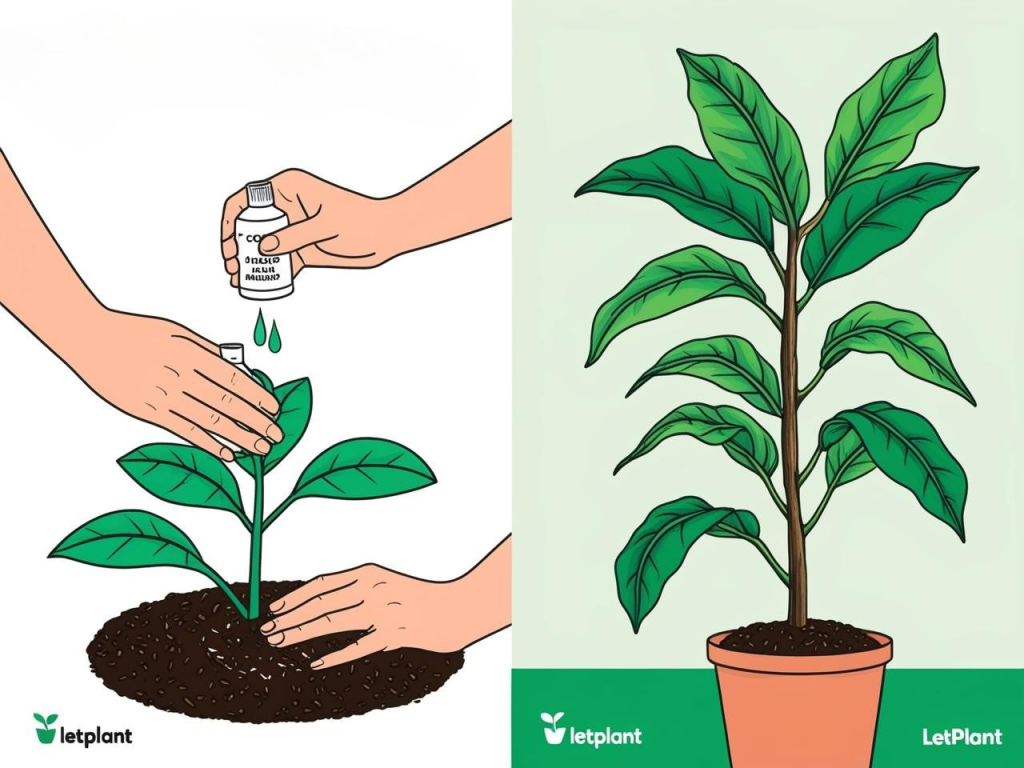
Coffee plants are moderate feeders. During the growing season (spring through early fall), fertilize regularly.
A balanced liquid fertilizer (e.g. a 10-10-10 NPK) diluted to half strength and applied every 2–4 weeks works well. In winter, reduce feeding to once a month or even pause, since growth naturally slows. Over-fertilizing can burn roots, so err on the side of weaker solution.
You can also give your coffee plant a boost by adding a couple teaspoons of used coffee grounds to the soil once in winter and again in spring.
This provides nutrients and helps maintain soil acidity. Always flush the soil with plain water occasionally (run water through it) to prevent salt build-up from fertilizers.
Coffee Plant Pruning and Shaping Techniques

Regular pruning keeps your coffee plant compact and healthy. Each spring, trim the plant to maintain shape and encourage new growth.
Use clean, sharp scissors or pruning shears. Start by removing any dead, broken, or overcrowded branches. Also remove any suckers (vertical shoots) growing from the base or lower trunk, unless you want to root them (see propagation below).
To make the plant bushier, cut back long stems. Always cut at a 45° angle just above a leaf node (the point where a leaf meets the stem).
This encourages lateral shoots. For example, if the plant is getting tall, trim the top of the main stem – the plant will then produce side branches and fill out. Pruning also improves air circulation inside the foliage, reducing disease risk.
Regular light pruning (pinching tips of new growth) can be done anytime to shape the plant. Removing a few inches from the top will encourage more branches.
Just be gentle and don’t remove more than about 1/3 of the green growth at once. After pruning, the plant may drop a few leaves temporarily, which is normal. Resume normal care, and it will bounce back with new shoots.
Coffee Plant Pest Prevention and Treatment

Indoors, coffee plants can occasionally attract sap-sucking insects. The most common pests are mealybugs, aphids, scale, and spider mites.
To prevent infestations, keep your plant clean and healthy. Dust the leaves gently every few weeks so pests have fewer hiding spots. Avoid overly wet leaves (dry surfaces discourage fungus and mildew).
Check your plant regularly – look under leaves and along stems for white fuzzy patches (mealybugs), sticky honeydew or black soot (aphids/scale), or fine webs (spider mites).
If you see pests, act quickly. Wipe them off with a cotton swab dipped in rubbing alcohol, or spray the plant with a gentle solution of insecticidal soap or neem oil. Repeat treatments as needed.
Quarantining new plants before introducing them to your collection can prevent infestations. Healthy plants are less likely to have major pest problems, so avoid overwatering (which weakens roots) and ensure good airflow around your coffee plant.
Common Problems & Fixes
Even with best efforts, issues can crop up. The good news is most are easy to fix once identified:
- Yellow leaves
 Often caused by overwatering or nutrient deficiencies. If leaves turn yellow and drop, check that the pot has drainage and adjust your watering schedule. Root rot from waterlogged soil can also yellow leaves.
Reduce watering if the soil is too wet. If watering is fine, the plant may need fertilizer; give a balanced feed and consider repotting if the soil is old or compacted. - Brown leaf edges or tips
 Likely due to low humidity or too much sun. Dry, crisp edges usually mean the air is too dry; raise humidity (see above).
Brown spots all over a leaf can be leaf scorch from direct sun or high heat – move the plant further from the sun and provide more filtered light. Brown spots in rings can also be fungal leaf spot; remove affected leaves and improve ventilation. - Leaf drop or wilting
 Could be temperature stress (sudden cold or heat) or inconsistent watering. Make sure the plant isn’t placed in a draft or near a heater/AC vent. Keep watering steady (not letting it dry out completely) and maintain humidity to reduce stress.
 - Slow growth or legginess
 Usually from insufficient light or being root-bound. If stems look long and spaced-out, try moving the plant to a brighter spot.
If growth stalls year after year, consider repotting to fresh soil and a slightly larger pot. Also ensure you’re fertilizing properly – lack of nutrients can stunt growth. - Pest damage
 As above, treat early with appropriate methods. Sticky residue or deformed leaves indicate pests. Neem oil or insecticidal soap usually handles common indoor pests effectively.
In short, monitor your plant weekly. Yellowing or browning is your cue to adjust water, light, or humidity. Catching problems early lets you fix the issue before serious damage occurs.
Coffee Plant Safe and Aesthetic Placement
Coffee plants have glossy green leaves and pretty white flowers (in ideal conditions), so they make attractive decor in a home or office. Place your plant where you can enjoy its looks and it can get proper light. Here are some friendly tips:
- Location
 A bright living room or kitchen corner works well. An east-facing window with morning sun is often perfect. South- or west-facing windows need sheer curtains to avoid harsh light. Avoid drafts – don’t put it right by an open window in winter or near an AC vent.
 - Decor
 Pick a sturdy, attractive pot that complements your decor. A simple neutral pot lets the foliage shine, or a colorful pot adds a pop of color.
A small stand or shelf can elevate the plant eye-level. In small apartments, a dwarf variety like C. arabica ‘Nana’ (only ~12″ tall) is ideal. Otherwise, you may need to rotate the plant’s position as it grows. - Safety
Remember that coffee plants are toxic to pets and children if ingested. Keep them in a room that’s out of reach of curious cats or dogs. - Humidity and grouping
 To keep humidity up, you can place the pot on a decorative pebble tray or near other moisture-loving plants (ferns, palms).
Bathrooms or kitchens (if they have light) are natural humid spots, but only if the temperature is warm enough and there’s indirect light.
Overall, coffee plants look lush and tropical, so they brighten up any indoor space. Just match the style of the plant and pot with your decor and give it a good vantage point near a window.
Long-Term Health and Propagation Tips
For a healthy, long-lived plant, continue the care routine year after year. Here are extra tips:
- Rotation & Cleaning

Every few months, rotate the pot so all sides of the plant get light. Dust the leaves gently with a soft cloth to keep stomata clear and light absorption efficient. - Repotting
As mentioned, repot every 2–3 years. This keeps the soil fresh and roots healthy. Each spring, check if roots circle the pot’s edge – if so, it’s time for a bigger pot. - Blooming and Fruit

With ideal care, an indoor coffee plant may bloom (white jasmine-like flowers) after 3–5 years. If it flowers, you’ll eventually get green coffee cherries that turn red – the fun result of all your care!
However, fruiting isn’t guaranteed indoors, and even if it does, it’s mostly for enjoyment rather than harvest (it takes thousands of berries to make a cup of coffee). - Propagation

You can multiply your coffee plant by stem cuttings or seeds. The quickest way is stem cuttings. In early summer, take an 6–8 inch cutting from a healthy branch. Remove all but the top 2 leaves.
Dip the cut end in rooting hormone and plant it in a small pot of moist potting mix. Cover the pot with a clear plastic bag or dome to maintain humidity, and keep it warm and out of direct sun.
Once roots form (a few weeks), remove the cover and care for it as a new plant.
You can also save ripe coffee “cherries” (if your plant fruits) for seed propagation.
Remove the seeds, dry them for a few days, soak overnight, then plant them a quarter-inch deep in damp mix, keeping them warm and moist until they germinate (often 6–8 weeks). Note: seeds must be fresh (old dried beans from the store won’t sprout). - Recovery

If your plant ever looks stressed (lost leaves or slowed growth), give it a rest: trim back watering and fertilizing slightly and make sure it’s in its prime location.
After a short recovery, resume normal care. Coffee plants can live and grow for many years with consistent care.
Overall, maintaining consistent warmth, humidity, and moisture is the key to a thriving indoor coffee plant. With time, you’ll be rewarded with lush growth (and maybe even coffee cherries!) under your care.
Quick-Reference Care Summary
| Care Aspect | Key Guidelines |
| Light | Bright, indirect light (4–6h/day); avoid direct sun which scorches leaves. |
| Water | Keep soil evenly moist. Water thoroughly when the top inch is dry, then let excess drain (do not let pot sit in water). |
| Temperature | 65–80°F (18–27°C) preferred. No cold drafts; avoid temps below ~60°F. |
| Humidity | High humidity (~50–60%). If air is dry, mist leaves or use a humidifier/pebble tray. |
| Soil & Pot | Rich, well-draining, slightly acidic mix (peat-based or with compost/perlite). Use a pot with drainage holes; repot every 2–3 years. |
| Fertilizer | Balanced liquid fertilizer (e.g. 10-10-10) at half strength. Feed every 2–4 weeks in spring/summer; reduce to once a month (or stop) in winter. Coffee grounds can be added once in winter/spring. |
| Pruning | Prune annually (spring). Remove dead/low branches and trim tops/crowded shoots to encourage fullness. Use clean shears. |
| Pests & Problems | Watch for mealybugs, aphids, spider mites. Treat infestations early with neem oil or insecticidal soap. Yellow leaves usually mean overwatering or nutrient deficiency; brown edges mean low humidity or sunscald. Adjust care accordingly. |
| Placement | Near bright window in living space; keep away from vents/heaters and drafts. Choose a decorative pot that matches your home. Remember the plant is toxic – keep away from pets/kids. |
| Propagation | Best by stem cuttings (8″ long, root in moist mix in summer). Can also grow from fresh coffee seeds (fruit) if available. |